Box Truck Movers And The $10,000 Cargo Filing Gap
What a box truck signs up for the day it starts hauling somebody's furniture instead of freight
A box truck full of furniture is not hauling freight
Two box trucks can be identical down to the wheelbase and live under different federal rulebooks. The one running pallets for a shipper is a property carrier. The one loading a family's dining room set is a household goods motor carrier, and that puts it under 49 CFR part 375, a consumer protection rulebook a general freight operator never has to read.
What decides it is not the truck. Under 49 CFR 375.103 a household goods motor carrier is one that in the ordinary course of business offers some or all of four services. Binding and nonbinding estimates, inventorying, protective packing and unpacking at personal residences, and loading and unloading at personal residences. Offer those and you are in, whatever the equipment looks like. Our box truck insurance page covers the rest of the rating. This piece is about the part that surprises people.
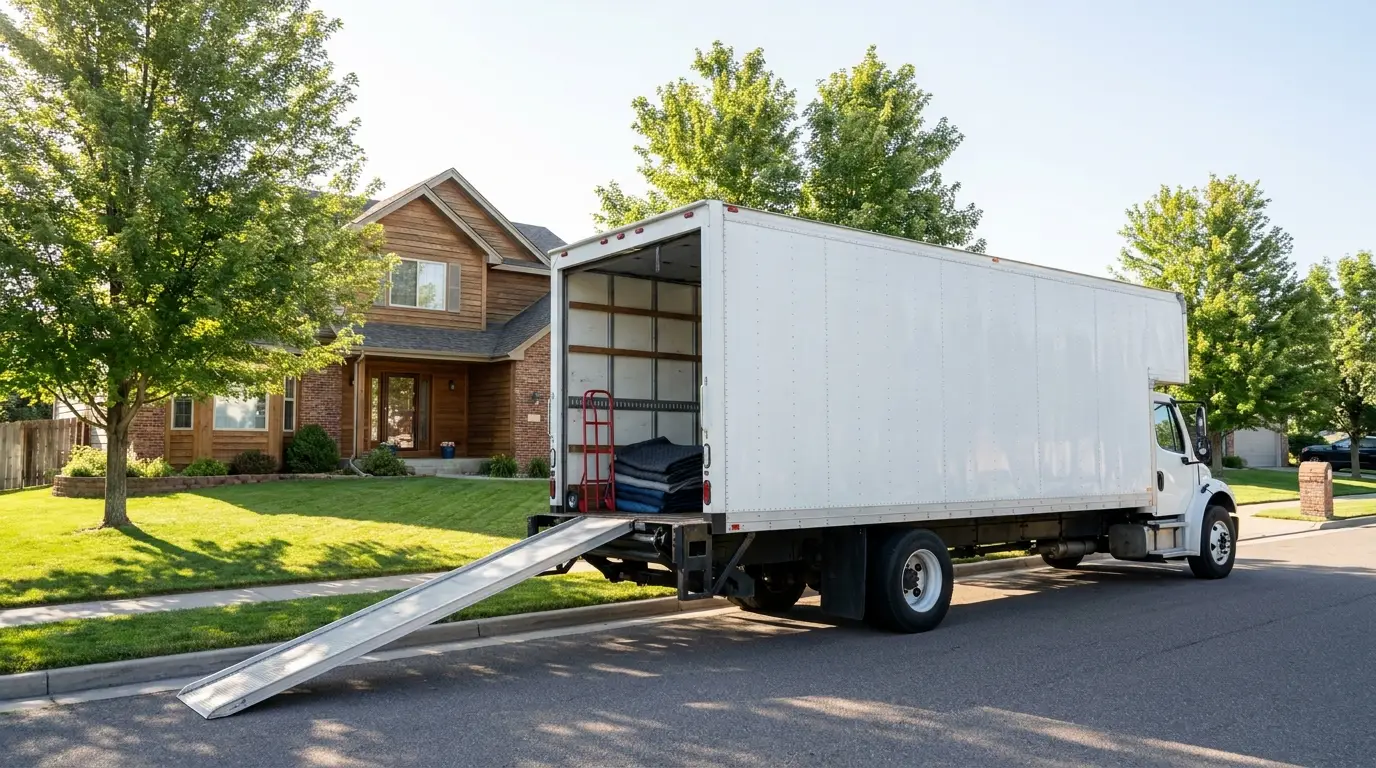
The federal cargo filing is not your coverage
Under 49 CFR 387.301(b), a household goods motor carrier cannot run in interstate commerce until a cargo surety bond or certificate of insurance has been filed with and accepted by FMCSA. Freight carriers hauling general commodities have no federal cargo filing at all, so a lot of movers assume the filing they are forced to make is the coverage they need.
Read the amounts. 49 CFR 387.303(c) sets the cargo security at $5,000 for loss or damage to household goods carried on any one motor vehicle, and $10,000 for the aggregate of losses at any one time and place. Those figures date to a 1982 rulemaking and they have never been adjusted. A single 26 foot load can carry ten times that in value before anyone packs a television.
The liability side of the same section shows the gap plainly. A freight vehicle of 10,001 pounds GVWR or more needs $750,000 of public liability under 387.303(b)(2)(i), and a fleet made up only of vehicles under 10,001 pounds needs $300,000 under 387.303(b)(1)(i). The bodily injury floor was written for modern exposure. The cargo floor was not, which is why the real limit belongs on your motor truck cargo policy rather than on the filing.
What you actually owe is set by the bill of lading
Your real exposure comes from 49 CFR 375.201(b). The Full Value Protection obligation makes you liable for goods that are lost, damaged, destroyed, or simply not delivered, in an amount equal to the replacement value, with the declared value of the shipment as the ceiling. That is the default. It applies unless something in writing changes it.
The customer can change it. Under 375.201(c) a shipper who waives Full Value Protection in writing drops you to the Surface Transportation Board released rates order, which the FMCSA booklet at appendix A to part 375 states as 60 cents per pound per article. A 40 pound television becomes a $24 claim. Same truck, same accident, a completely different number.
There is a middle tier. Under 375.203(b), when goods move at a value above 60 cents per pound per article, your liability on an unusually valuable item can be held to $100 per pound per article if the shipper never told you in writing it was worth more. Under 375.203(c) written notice restores full recovery up to the declared value. The paperwork, not the damage, decides the size of the claim.
Claim handling runs on a federal clock
Once a customer files, the timing stops being a service question and becomes a compliance one. Under 49 CFR 370.5(a) you have 30 days to acknowledge a written claim unless you have already paid or declined it. Under 370.9(a) you have 120 days from receipt to pay, decline, or make a firm compromise settlement offer in writing, and a written status letter every 60 days while it stays open.

How you value it is prescribed too. 370.9(b) tells a household goods carrier to use the replacement cost of the item as the base and then apply a depreciation factor to reach current actual value. That is not how a general freight cargo claim is measured.
Then there is arbitration. 49 CFR 375.211 requires every household goods carrier to run an arbitration program with eleven specific elements. The one that shapes your loss picture is 375.211(a)(7), which makes arbitration binding on you for any claim of $10,000 or less the shipper takes there. Above that you have to agree as well under (a)(8), the arbitrator has 60 days to decide under (a)(10), and (a)(6) bars a pre dispute arbitration agreement.
Why underwriters are paying attention right now
Transport Topics reported on September 17, 2026 that Moving and Storage Conference members held a record 80 meetings on Capitol Hill pressing for expanded FMCSA enforcement authority against fraudulent operators and dedicated funding for household goods fraud investigations. FMCSA already runs Operation Protect Your Move, aimed at the carriers and brokers with the worst records in the National Consumer Complaint Database. That database is public, and a clean complaint history is now part of how a mover gets quoted, alongside the loss runs and the drivers.
Get the limit right before the first full load
If your box truck is moving households, size the cargo limit to a full load at replacement value rather than to the federal filing, and make sure the valuation wording on your bill of lading matches what the policy expects. Get a truck insurance quote in under a minute on our quote form, or call or text 423-264-4255. The coverage detail sits on our box truck insurance page.
Common questions
Does the federal cargo filing set my coverage limit?
No. The $5,000 per vehicle and $10,000 per occurrence figures in 49 CFR 387.303(c) are the minimum security a household goods carrier must file with FMCSA before it can run interstate. Your actual liability comes from 49 CFR 375.201(b), which is replacement value up to the declared value of the shipment. Size the cargo limit to a full load, not to the filing.
What is the difference between Full Value Protection and 60 cents per pound?
Full Value Protection is the default under 375.201(b) and makes you liable for the replacement value of what is lost or damaged, capped at the declared value. Under 375.201(c) a shipper can waive that in writing and drop you to the released rate, which the FMCSA booklet at appendix A to part 375 states as 60 cents per pound per article. The waiver has to be in writing to count.
How long do I have to answer a customer's damage claim?
Thirty days to acknowledge the claim in writing under 49 CFR 370.5(a), unless you have already paid or declined it in that window. Then 120 days from receipt to pay, decline, or make a firm compromise settlement offer under 370.9(a), with a written status update every 60 days after that while the claim stays open.
Do these rules apply if I only move people inside one state?
Part 375 is written for interstate moves, so a purely intrastate mover answers to state rules instead, and those vary widely. Plenty of box truck operators do both without realizing the second one changes their obligations. Call or text 423-264-4255 and we will sort out which side of the line you are on before you get a truck insurance quote.
Ready for a better rate?
We shop A-rated carriers against each other to find your lowest rate, fast. Under a minute to start, and no obligation.
Prefer to talk it through? Call or text (423) 264-4255 and a licensed agent will walk you through your options.