Colorado Chain Season Starts Sept 1 and Penalties Rise Aug 12
Two Colorado deadlines land in the next month. Here is what the I-70 mountain corridor rules actually cost a one truck operation, and where the real exposure sits.
Two Colorado deadlines land in the next month
If you run Colorado at all, put two dates on the calendar. On August 12, 2026, Senate Bill 26-035 takes effect and raises penalties on a list of traffic violations, including the fine for hauling hazardous materials out of compliance. Governor Jared Polis signed it May 27. Then on September 1 the chain carry season opens, and every commercial truck on the covered highways needs chains aboard whether or not a flake has fallen.
Neither is a headline outside the Rockies, and that is the problem. Colorado stacks more truck specific rules onto one interstate than almost any state, and most carry a dollar figure. Before you look at how your commercial truck insurance in Colorado is built, it helps to see the whole stack in one place.
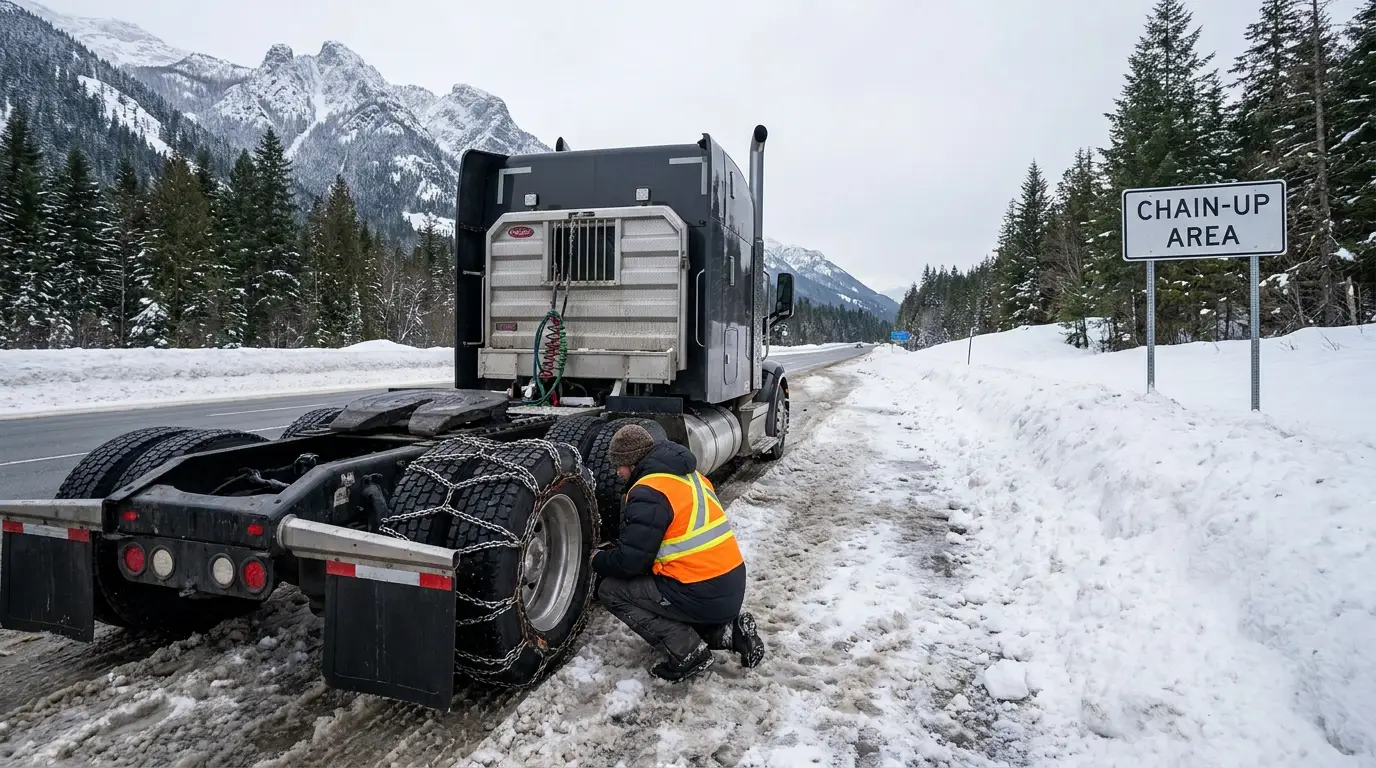
What the Must Carry law actually requires
The requirement comes from Senate Bill 24-100. From September 1 through May 31, commercial vehicles over 16,000 pounds used in commerce, or built to carry 16 or more passengers, must carry chains on the covered routes. CDOT puts that at more than 1,400 centerline miles of highway, including I-70, Colorado 9, and US 40, 50, 160, 285 and 550. On I-70 the core stretch runs from milepost 133 at Dotsero east to milepost 259 near Morrison.
Carrying is one thing and using them is another. Colorado runs two levels. Under Code 17, single drive axle combination vehicles chain all four drive wheels and cables are not accepted, while everything else needs snow tires or chains. Under Code 18 every commercial vehicle chains up. CDOT counts 130 designated chain stations statewide, 22 of them on the I-70 mountain corridor.
The ticket is the small number
Per FreightWaves, the fine structure runs in tiers. Not carrying chains on a covered stretch is $50 plus a $17 surcharge. Failing to chain up when the chain law is actually in effect is $500 plus a $79 surcharge. Blocking the highway because you did not chain is $1,000 plus a $157 surcharge. Some towns go further on their own roads. Vail set its penalties at $1,500 for a chain violation and $2,650 for blocking traffic in March 2025.
Enforcement is real. CDOT reported more than 1,300 citations during the 2024 to 2025 chain season. Colorado State Patrol accounted for 976 citations for failing to comply and another 120 where the violation shut a road down. Those closures are why lawmakers keep coming back to this. Senate Bill 25-069, signed May 15, 2025, created a CDOT permit program so private vendors can sell and install chains at designated sites, a model already running in California, Washington and Oregon.
The lane rules that came with it
Senate Bill 24-100 did more than chains. Trucks at 16,000 pounds and above are barred from the far left lane on six high risk stretches of I-70 where three or more lanes run in one direction, at Floyd Hill, Georgetown Hill, the Eisenhower Tunnel approach, Dowd Junction, Vail Pass and Glenwood Canyon. Passing is still allowed. The fine runs up to $100. The same law created commercial vehicle speed enforcement zones through Glenwood Canyon, eastbound from milepost 116 to 131 and westbound from 118.5 to 131, where a speeding fine for a truck is doubled.
CDOT and the State Patrol added markings and signage and announced active enforcement in December 2025. CDOT executive director Shoshana Lew said that when a semi blocks the left lane on Vail Pass or the tunnel approach it can shut down travel for hours. Points matter more than the fine here, because Senate Bill 26-035 raises the points for improper passing from four to eight on August 12.
Why a mountain grade crash prices differently
Here is the part that belongs in an insurance conversation. On a flat interstate a bad day is usually one truck and one other vehicle. On I-70 in weather it is rarely that contained. On April 14, 2026, roughly 70 vehicles piled up near the Eisenhower Tunnel in Clear Creek County. Nineteen people were evaluated on scene, eight went to hospitals, one was seriously injured, and eastbound lanes stayed shut for hours.
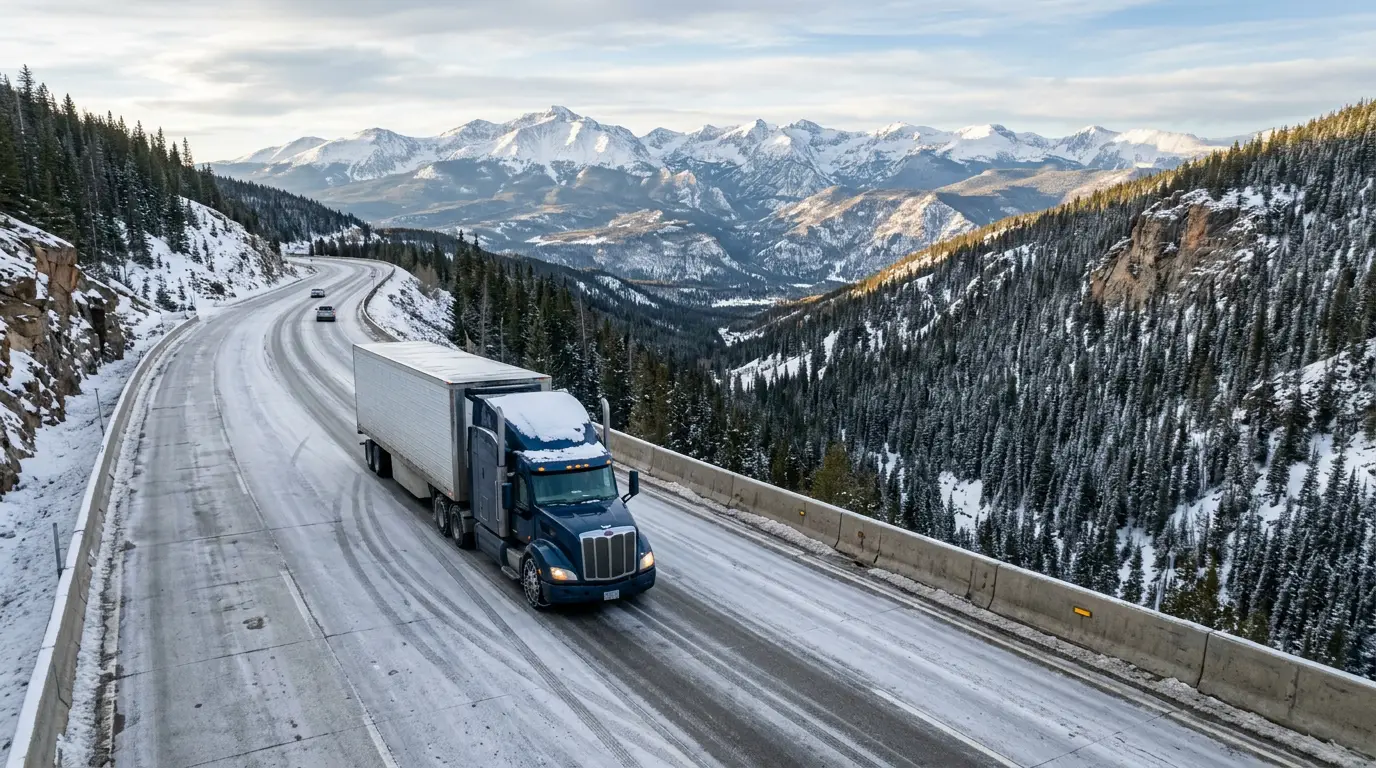
A pileup is a multi claimant event, and that is how a small carrier finds out its limits were sized for a different kind of crash. It becomes a commercial auto liability question long before it is a legal one. The unit is a separate problem, because a slide on a grade with a barrier wall instead of a shoulder tends to total equipment rather than dent it, which is what physical damage is for. And a load sitting on a closed interstate for hours, or dropped at an unfamiliar yard while the corridor clears, is where your motor truck cargo limit and its unattended vehicle language get read closely.
Worth saying clearly, none of the fines above are insurable. You pay those. What insurance answers is the crash the rules exist to prevent, plus the citation and any out of service order feeding the federal safety data an underwriter pulls at your next renewal.
Before chain season opens
Check that chains for your axle configuration are on each truck and fit the tires currently mounted, and make sure drivers know where the 22 I-70 chain stations are before a storm rather than during one. Then look at whether your limits match a corridor that produces 70 vehicle pileups.
See our Colorado truck insurance page for how we write this state, then call or text 423-264-4255 or get a truck insurance quote and we will go through your limits against the lanes you actually run.
Common questions
When does Colorado's chain law start and who does it apply to?
Colorado's chain carry season runs September 1 through May 31. Under Senate Bill 24-100, commercial vehicles over 16,000 pounds used in commerce, or designed to carry 16 or more passengers, must carry chains on the covered routes during that window even when no chain law is posted. CDOT says the requirement covers more than 1,400 centerline miles, including I-70 between milepost 133 at Dotsero and milepost 259 near Morrison.
What does a Colorado chain law violation cost?
Per FreightWaves the fines run in tiers. Not carrying chains on a covered stretch is $50 plus a $17 surcharge. Not chaining up when the chain law is in effect is $500 plus a $79 surcharge. Blocking the highway because you did not chain is $1,000 plus a $157 surcharge. Vail set higher municipal penalties in March 2025 at $1,500 for a violation and $2,650 for blocking traffic.
Can trucks use the left lane on I-70 in Colorado?
Only to pass. Trucks at 16,000 pounds and above are kept out of the far left lane on six stretches of I-70 where three or more lanes run one direction, at Floyd Hill, Georgetown Hill, the Eisenhower Tunnel approach, Dowd Junction, Vail Pass and Glenwood Canyon. The fine runs up to $100 and carries license points. Glenwood Canyon also has commercial vehicle speed enforcement zones where a truck speeding fine is doubled.
Does a Colorado citation or out of service order affect my insurance rate?
The fine itself is not insurable, but the record behind it is. Citations and out of service orders feed the federal safety data underwriters review at renewal, and recent entries carry the most weight. A clean winter through the I-70 corridor is one of the few things a small carrier controls in its own pricing. Call or text 423-264-4255 and we will get a truck insurance quote together and show you where your record helps or hurts.
Ready for a better rate?
We shop A-rated carriers against each other to find your lowest rate, fast. Under a minute to start, and no obligation.
Prefer to talk it through? Call or text (423) 264-4255 and a licensed agent will walk you through your options.