The 24 Hour Restart Dump Trucks Get And Where It Ends
What 49 CFR 395.1(m) actually gives a construction hauler, the 75 air mile line that takes it back, and the records that settle it after a crash
Dump work runs on an hours rule most fleets never name
Federal hours of service caps a property carrier at 60 hours on duty in any 7 consecutive days, or 70 in any 8 if the carrier runs vehicles every day of the week. That is 49 CFR 395.3(b), and the usual way to clear that clock is 34 consecutive hours off duty under 395.3(c).
Construction hauling has a shorter version. Under 49 CFR 395.1(m), a driver used primarily in the transportation of construction materials and equipment may end any period of 7 or 8 consecutive days with the beginning of any off duty period of 24 or more successive hours. Ten hours of difference does not sound like much until paving season. It is a Saturday you can load instead of one you cannot, and it is part of what an underwriter reads behind the rate on dump truck insurance, because hours available is exposure available.
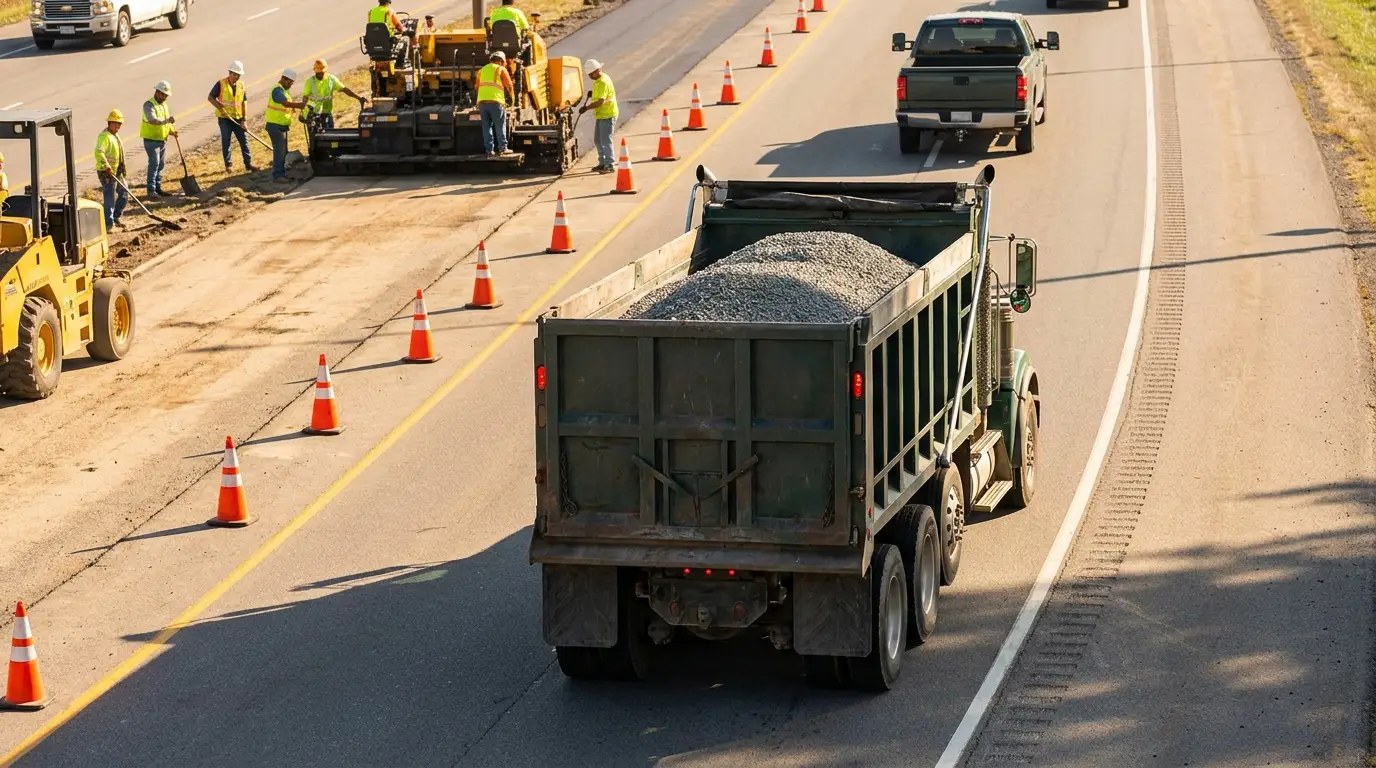
The exception only lives inside a 75 air mile circle
The real work happens in the definition at 49 CFR 395.2. Transportation of construction material and equipment means construction and pavement materials, construction equipment, and construction maintenance vehicles moved by a driver to or from an active construction site, within a 75 air mile radius of that driver's normal work reporting location. Active is defined too. It is a site between mobilization of equipment and materials to the site and final completion of the construction project.
Two more lines are worth knowing. A state may notify the FMCSA Administrator and set a different radius, as long as it lands between 50 and 75 air miles and applies only to movements that stay entirely inside that state. And the whole thing stops at hazmat, since material found hazardous under 49 U.S.C. 5103 in a quantity that requires placarding is carved out of the definition.
So the exception can walk away from you in three ordinary ways. The load runs past the ring. The job reaches final completion and the hauls keep going anyway. Or the run has nothing to do with a site at all, which is what a yard to yard delivery or a spot haul off a load board usually is.
It resets the week, not the day
This is the part that gets misread on a jobsite. Nothing in 395.1(m) touches the daily clocks. A driver still may not drive without first taking 10 consecutive hours off duty, still may not drive after the 14th consecutive hour following that break, and still may drive a total of 11 hours inside the window. Driving also stops after 8 hours of driving time without a consecutive 30 minute interruption, unless the driver qualifies for a short haul exception. All of it sits in 395.3(a).
The proof is thinner than the rule
Most dump running also fits the short haul exception at 395.1(e)(1), which exempts the driver from 395.8 and 395.11 entirely. No record of duty status, no electronic logging device, no supporting documents. The conditions are a 150 air mile radius, which the rule converts to 172.6 statute miles, a return and release within 14 consecutive hours, and 10 consecutive hours off between tours. In exchange the carrier keeps 6 months of accurate and true time records showing report time, total hours on duty, and release time.
Where duty status records are kept instead, 395.8(k)(1) sets retention at not less than 6 months, and 395.11 adds supporting documents, turned in by the driver within 13 days, up to 8 for any 24 hour period, counting dispatch records, bills of lading and payroll. That stack is the only thing standing behind a legal week when an exception is what you relied on.
Where it shows up on a claim and at renewal
After a serious crash the fatigue theory arrives early, and the first discovery request is the week before it. If the fleet restarted on 24 hours while the tickets show hauls 90 air miles out, or deliveries to a job that reached final completion in the spring, those movements are not what the definition describes and the week gets argued back under the 34 hour rule. That is not a paperwork dispute. It is a fatigue narrative built out of your own records, aimed at your commercial auto liability limit.
Roadside interest is not fading either. FreightWaves reported on June 30, 2026 that the California Highway Patrol Border Division commercial vehicle unit stepped up inspections around El Centro with hours of service and driver fatigue named as a focus. That same 75 air mile line is also the shape an underwriter prices, since a rate is built off the radius of operation rather than your odometer. A fleet that files as local and then runs a summer of longer hauls has drifted on two documents at once.
The practical version is short. Write down the reporting location each driver is actually dispatched from, keep the 6 months of time records, and tell your agent when the work moves outside the ring. A quote for dump truck coverage is only as good as the radius and the hours it was built on.
Get the quote before the season changes your radius
We write commercial truck insurance for dump and aggregate operations every week and we know the difference between a site hauler and a fleet that has quietly turned regional. Get a truck insurance quote in under a minute through our quote form, or call or text 423-264-4255 and we will price the operation you are running now.
Common questions
Does the 24 hour restart replace the 34 hour restart for every dump truck?
No. 49 CFR 395.1(m) applies to a driver used primarily in the transportation of construction materials and equipment as 395.2 defines that term. A driver who does not fit the definition uses the ordinary restart of 34 or more consecutive hours off duty under 395.3(c).
What happens if one load runs past 75 air miles?
That movement sits outside the 395.2 definition, so it does not support the primarily test the exception rests on. One trip is not a verdict by itself, but a season of them is a pattern, and the pattern is what an enforcement officer or a plaintiff attorney reads out of your dispatch records.
Does the exception change the 11 hour and 14 hour limits?
It does not. 395.1(m) only ends a 7 or 8 day period sooner. The 10 consecutive hours off before driving, the 14 hour window, the 11 hours of driving inside it, and the 30 minute interruption after 8 hours of driving all stay exactly where 395.3(a) puts them.
How does any of this reach my premium?
Hours available and radius are two of the largest inputs in a dump truck rate, and both get verified from records after a loss rather than taken on trust. Keep the time records and tell your agent when the work moves. Call or text 423-264-4255 to get a truck insurance quote built on the operation you are actually running.
Ready for a better rate?
We shop A-rated carriers against each other to find your lowest rate, fast. Under a minute to start, and no obligation.
Prefer to talk it through? Call or text (423) 264-4255 and a licensed agent will walk you through your options.