Georgia Is Building Truck Only Lanes on I-75 and It Changes Who You Crash Into
Georgia DOT has locked the design and the schedule for 41 miles of barrier separated truck only lanes on northbound I-75. Here is what happens to a small carrier's claims when nearly every vehicle around you is a loaded truck.
Georgia is about to separate trucks from cars on 41 miles of I-75
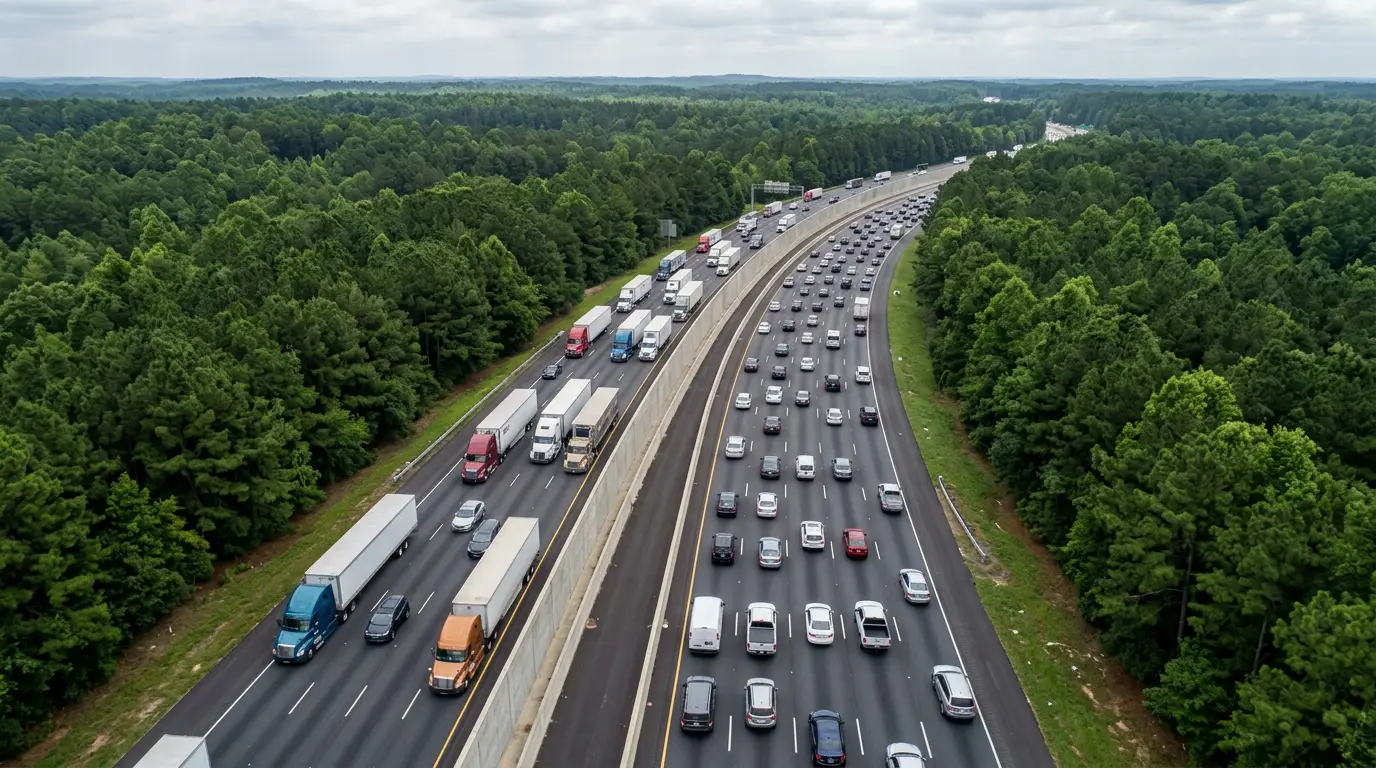
FreightWaves reported in July 2026 that the Georgia Department of Transportation has finalized the design and the construction timeline for its I-75 Commercial Vehicle Lanes project. Two new lanes, barrier separated, northbound only, reserved for commercial vehicles. They run 41 miles from the I-75 and I-475 interchange in Monroe County near Macon up to the State Route 20 interchange in Henry County, crossing Monroe, Lamar, Butts, Spalding and Henry counties. Construction starts in 2027 and GDOT expects to be finished by the end of 2032. The current estimate is roughly $3.5 billion and there is no toll. Vehicles running more than six wheels are expected to use the new lanes unless they are taking a local exit inside the project limits, and GDOT projects that 73 to 100 percent of trucks will end up in them depending on where they enter. If you run that corridor it is worth reading now, and it pairs with what we cover on commercial truck insurance in Georgia.
McDonough is already one of the worst freight chokepoints in the country
The American Transportation Research Institute put I-75 at McDonough tenth on its 2026 Top 100 Truck Bottleneck list. Georgia did not stop there. Atlanta's I-285 at I-85 north ranked third, I-75 at I-285 north ranked fifth, and I-20 at I-285 west ranked sixth. The state placed nine locations in the top 100, second only to Texas. GDOT says truck traffic on the McDonough stretch is approaching 30 percent of average daily traffic, an unusually high share for a general purpose interstate, and expects it to keep climbing. At the ten worst bottlenecks nationally, average peak hour truck speed drops to 29.6 miles an hour.
That volume is not shrinking. Land Line reported that GDOT opened the $126 million Brampton Road Connector on July 16, 2026, a four lane link running from Garden City Terminal Gate 3 straight to I-16 as part of a $600 million cargo belt around Savannah. Commissioner Russell R. McMurry said the project was built to move port freight better while getting trucks off local streets. Freight that clears Savannah faster still has to go somewhere, and a great deal of it heads north.
When the traffic separates, your crash partner changes
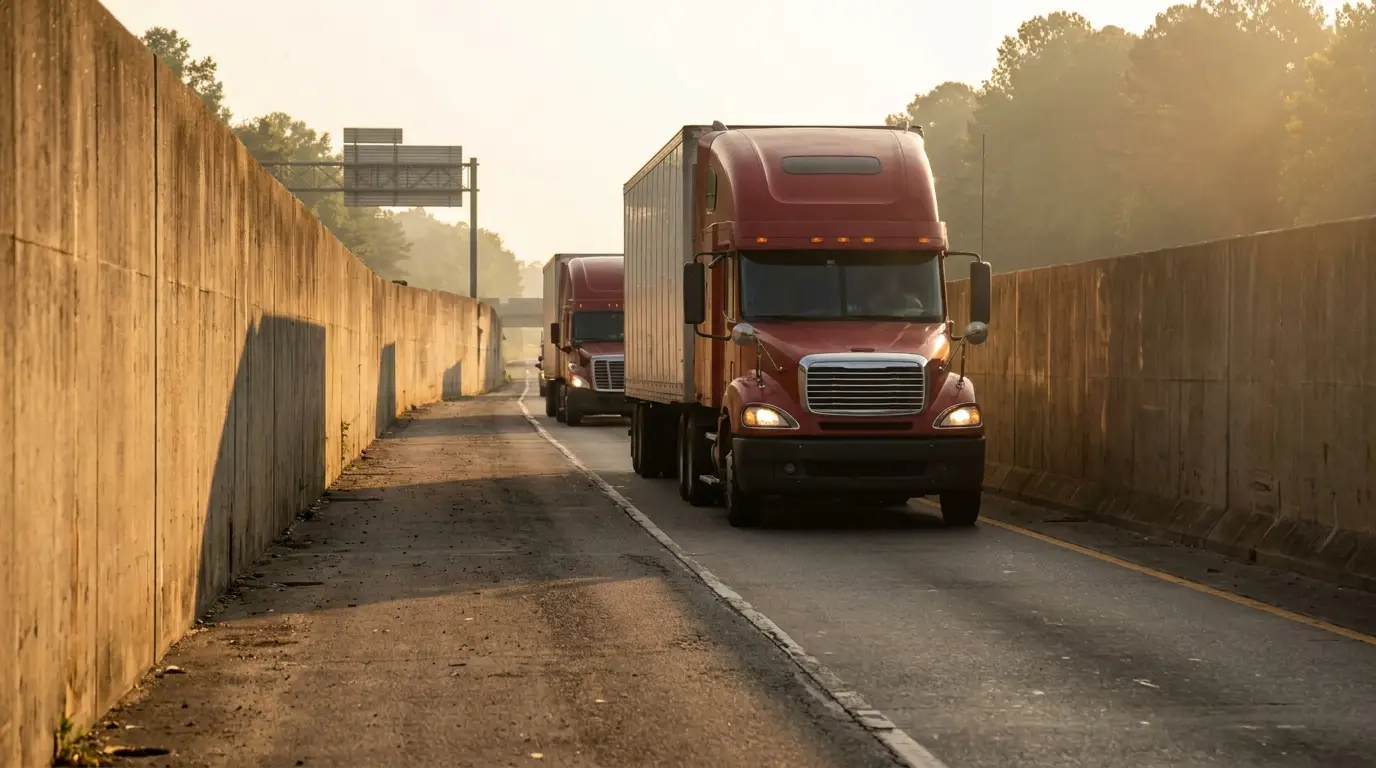
Here is the part that does not appear on the project fact sheet. Today most of what surrounds you on I-75 is passenger vehicles. Inside a barrier separated commercial lane, the vehicle ahead of you, behind you and beside you is another loaded truck. GDOT's own analysis expects fewer crashes overall because the traffic is more channelized, and that is a real safety gain worth having. The crashes that still happen simply change character.
Rear ending a sedan is one damaged car and one set of injuries. The same closing speed into the back of a tractor trailer is a totaled truck, a totaled trailer, another carrier's freight, that owner operator's lost income for as long as the replacement takes, and recovery on a road with no room to work. All of it lands on your commercial auto liability. Carriers who bought the federal $750,000 minimum because it was the legal floor tend to learn the hard way that a floor was never meant to be a target.
A barrier on both sides takes away your out
Concrete on your left and concrete on your right means there is no shoulder to steer for and nowhere to put a disabled unit. A blown steer tire that would be a rough afternoon on an open interstate becomes a blocked lane with traffic stacked behind it. Recovery gets slower and more expensive when a wrecker cannot get around the wreck, and heavy tow bills on restricted access roadway are not small money. That is a physical damage question well before it is a liability question, which is why a stated value that has gone stale hurts twice, once on the truck and once on the tow.
The freight you never loaded can still land on your policy
If you are the striking vehicle in a truck on truck crash, the contents of the other trailer become a claim against you, and you have no idea what is in it. It might be paper towels. It might be electronics rolling out of Savannah. Your own load is a motor truck cargo matter and the other carrier's load is a liability matter, and neither one asks your permission first. Sizing limits against the freight in your own trailer is only half the exercise on a corridor where everything around you is commercial.
Six years is plenty of time to get ahead of it
Nothing about 2032 demands action this week. What does deserve attention is that McDonough already ranks tenth in the country and the freight leaving Savannah is growing now. Test your liability limit against a truck on truck loss instead of a car, confirm your stated values match what a replacement tractor actually costs today, and read your towing and recovery language before the night you need it. If you are not sure where you stand, we can price it against your real radius and your real loss history, and our Georgia truck insurance page covers what we write in the state. Get a truck insurance quote in under a minute through our quote form, or call or text 423-264-4255 and we will walk the numbers with you.
Common questions
Will trucks be required to use the new I-75 lanes in Georgia?
GDOT's plan calls for vehicles with more than six wheels to use the commercial vehicle lanes unless they are taking a local exit inside the project limits, and the agency projects 73 to 100 percent of trucks will end up in them. Construction begins in 2027 with completion expected by the end of 2032, and there is no toll to use them.
Do truck only lanes mean I should carry higher liability limits?
It is worth a hard look. In a lane where nearly every vehicle is commercial, the vehicle you hit is a tractor, a trailer, another carrier's freight and that operator's lost income all at once. The federal minimum of $750,000 for general freight was set as a floor, not as a limit sized to a modern truck on truck loss. Call or text 423-264-4255 and we will price the difference between limits so you can see it in dollars.
Does physical damage coverage pay for towing and recovery?
Often yes, but the amount is the issue. Many policies carry towing and recovery as a sublimit or as a separate coverage rather than as an open ended promise, and a heavy recovery on a barrier separated roadway with no shoulder can run well past a small sublimit. Read that line on your current policy before you need it.
How do I get a truck insurance quote for a Georgia based truck?
Send us your DOT number, your radius, the units you run and your loss history and we will shop it. You can get a truck insurance quote through the form on our home page in under a minute, or call or text 423-264-4255 during business hours and talk it through with a person.
Ready for a better rate?
We shop A-rated carriers against each other to find your lowest rate, fast. Under a minute to start, and no obligation.
Prefer to talk it through? Call or text (423) 264-4255 and a licensed agent will walk you through your options.