Indiana Is Weighing Your Truck Without a Scale House
Indiana is expanding weigh in motion and virtual weigh in motion sites through 2030. The axle that trips one is usually the load that shifts.
Indiana is moving the scale onto the highway
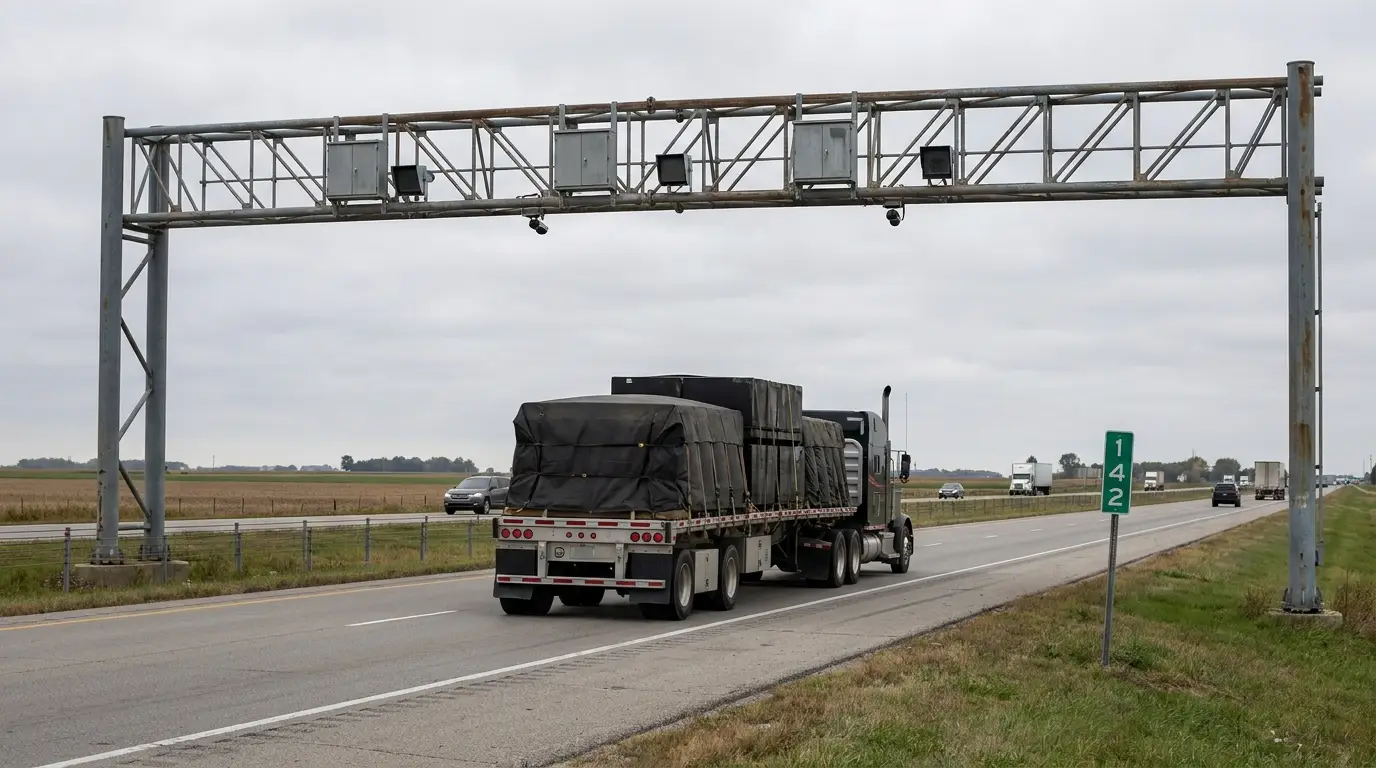
Indiana is expanding the equipment that weighs your truck while you are still rolling. Truck News reported on April 30 2026 that the Indiana Department of Transportation signed two four year agreements with the vendor Quarterhill, worth a combined 13 million dollars and running from May 1 2026 through April 30 2030, covering weigh in motion and virtual weigh in motion equipment, software, installation, calibration and maintenance across the state highway network.
The word virtual is the part worth reading twice. A virtual site adds connectivity, image capture and real time roadside access, with the stated purpose of improving enforcement efficiency while letting compliant trucks keep moving. The agreement also gives INDOT video based classification that identifies vehicles with computer vision instead of sensors buried in the pavement, so a screening point no longer needs a building or a ramp.
The state has reason to spend the money. INDOT counts 724 million tons of freight moving through Indiana each year, which it says makes Indiana the fifth busiest state for commercial freight traffic, and as much as one third of it crosses without stopping. Whether you buy commercial truck insurance in Indiana or just run the I-65 and I-70 lanes through it, plan on being weighed somewhere you cannot see it happening.
The number that catches you is the axle, not the gross
Most drivers carry one number in their head, 80,000 pounds. Indiana enforces four. The Indiana State Police summary of Title 9 Article 20 sets maximum gross at 80,000 pounds, a single axle at 20,000, a tandem at 34,000 and a tri axle at 50,000. It also caps wheel weight at 800 pounds per inch of tire width, measured between the flanges of the rim. That last rule is the one almost nobody quotes, and it quietly lowers your legal capacity when you spec narrower rubber.
Indiana also wrote the bridge formula into state law in 1975 and kept a grandfather provision for configurations the formula would penalize, holding those to 73,280 pounds gross with 16,000 pounds on an individual axle inside a tandem group. Legal weight there depends on axle spacing, configuration and tires, not one round number. A truck that scales 79,400 pounds gross can still be over on the drives, and a weigh in motion sensor reads every axle separately.
Bad distribution is a claims problem before it is a ticket
Here is the part that never makes the compliance webinar. The load that puts you over on a tandem is almost always freight sitting too far forward or too far back. That same imbalance is what moves when you stand on the brakes.
A load that shifts is damaged freight, and damaged freight is a motor truck cargo claim with a consignee refusing delivery. Weight carried high or off center also shortens the margin before a trailer goes over on a ramp, and a rollover is a totaled trailer plus a heavy recovery invoice, both landing on physical damage coverage and on whatever stated value you last gave your agent. Sliding the tandems and scaling before you reach the interstate fixes both problems with one stop.
What an overweight record does to a liability claim
No standard commercial auto form excludes running overweight, so the exposure is not a denied claim. It is an argument handed to somebody else. Weight adds stopping distance. If a crash happens on a trip where a weight record puts your truck over the limit, the other side does not have to prove you were speeding. They argue the truck could not stop in the distance a legal one would have, and the record supplies the premise. Automated screening makes that record routine, because the measurement exists whether or not an officer hands you paper. That is a commercial auto liability problem, and it is why limits sized against a bumper tap age badly.
The money side carries no coverage at all. Indiana civil penalties reach 1,000 dollars for a first permit violation and 1,500 after that, and 2,500 dollars for a first offense of running without a required permit with 5,000 after. Where no permit was available, excess weight runs 500 dollars at 1,000 to 4,999 pounds over, 1,000 at 5,000 to 9,999 pounds and 5,000 at 10,000 pounds or more. No policy reimburses a fine or the hours you lose redistributing a load on the shoulder.
What to do before your next Indiana run
Weigh loaded on a certified scale and keep the ticket, because a dated ticket is the cleanest rebuttal to a sensor reading you want to dispute. If your freight regularly puts you between 80,000 and 120,000 pounds, pull the overweight divisible load permit through Indiana Department of Revenue Motor Carrier Services and stay on the route it names. Then tell your agent what you actually haul and how heavy, because an underwriter who priced general freight at 78,000 pounds did not price a permitted load at 116,000.
We place coverage for owner operators and small fleets running Indiana every week, and we would rather size your limits now than after a sensor writes the first line of somebody else's argument. Get a truck insurance quote in under a minute on our quote form, or call or text 423-264-4255 and we will go through your weights and your Indiana truck insurance options together.
Common questions
Does Indiana weigh trucks without a scale house?
Yes. INDOT is expanding weigh in motion and virtual weigh in motion sites under agreements that run from May 2026 through April 2030. Virtual sites add image capture and real time roadside access, and the package includes video based vehicle classification that works without sensors in the pavement, so a truck can be screened at highway speed with no scale house in sight.
What are the legal truck weight limits in Indiana?
The Indiana State Police summary of Title 9 Article 20 lists 80,000 pounds gross, 20,000 pounds on a single axle, 34,000 pounds on a tandem, 50,000 pounds on a tri axle, and a wheel weight limit of 800 pounds per inch of tire width. A grandfather provision holds some older configurations to 73,280 pounds gross with 16,000 pounds on an individual axle inside a tandem group.
Will an overweight ticket raise my truck insurance?
Running overweight is not excluded on a standard form, so it is not a coverage denial. The damage is slower. The violation becomes part of the record an underwriter reads at renewal and part of what a plaintiff attorney can use after a crash. Call or text 423-264-4255 and we will tell you how your record is actually pricing.
Do I need a permit to run over 80,000 pounds in Indiana?
Yes. An overweight divisible load over 80,000 pounds and up to 120,000 pounds needs a permit from Indiana Department of Revenue Motor Carrier Services, and the permit designates a route you have to stay on. Get a truck insurance quote before you take that freight so your limits and your described operation match the heavier configuration.
Ready for a better rate?
We shop A-rated carriers against each other to find your lowest rate, fast. Under a minute to start, and no obligation.
Prefer to talk it through? Call or text (423) 264-4255 and a licensed agent will walk you through your options.