What Kansas Dust Storms Do to a Truck Claim
Blowing dust on I-70 is a five month operating condition in western Kansas, and the state and federal rulebooks do not agree on what a stopped truck should do about it.
Kansas put a name on the dust problem in December
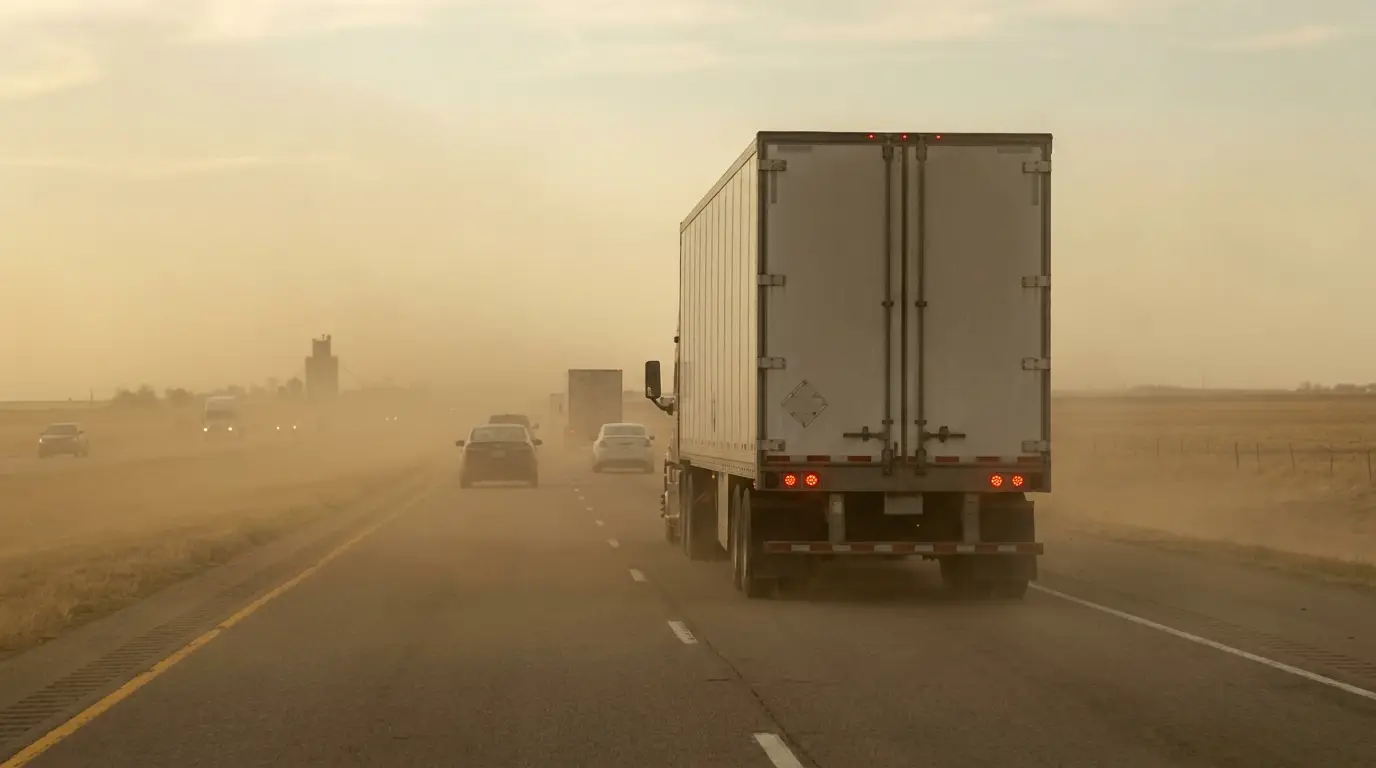
On December 17, 2025 the Kansas Department of Transportation and the Kansas Highway Patrol launched a safety campaign called Pull Off, Lights Out. It exists because blowing dust on the western Kansas plains can take visibility to nothing in seconds. KDOT and KHP say the season runs December through April and the western half of the state gets the worst of it, where flat ground, open farm fields, drought and steady wind all line up. KHP Technical Trooper Tod Hileman put it simply, saying a windy day in Kansas can turn dangerous fast.
If your trucks run I-70 west of Salina, or the grain and cattle lanes around Garden City, Dodge City and Colby, that is your operating environment for five months a year. It is also a set of facts an underwriter is already pricing when you shop commercial truck insurance in Kansas.
The shoulder is not a safe place to hide
On February 18, 2026 blowing dust on eastbound I-70 in Thomas County, on the stretch between Colby and Oakley, started a six vehicle chain reaction. The Kansas Highway Patrol reported that a semi driver could not see and slowed down, and a vehicle behind the truck rear ended it. Both of those vehicles then pulled off the interstate. Three more vehicles hit them there. Gary Stoll of Oakley died of his injuries and five other people were hospitalized.
Read that order of events twice. The units that did the right thing and got clear of the travel lanes were struck anyway. A parked truck in a brownout is not out of the crash. It is a large stationary object nobody sees until they are on top of it, and every vehicle that finds it arrives as another claim.
Two rulebooks disagree about your lights
Here is the part that catches carriers. The Kansas guidance tells a stopped driver to pull completely off the roadway, turn off every light including headlights and emergency flashers, set the parking brake and take a foot off the brake pedal, then stay belted in the cab until visibility returns. The reasoning is sound. In a brownout people steer toward the only thing they can see, and a lit taillight becomes an aiming point.
Federal rule 49 CFR 392.22 says close to the opposite. When a commercial motor vehicle stops on a highway for any reason other than a necessary traffic stop, the driver must activate the hazard warning flashers immediately and keep them flashing until warning devices are placed, and those devices go out within 10 minutes. On a divided highway that means one device within 10 feet of the rear on the traffic side and the others back at 100 feet and 200 feet toward approaching traffic.
So state safety advice and the federal rule your driver is inspected against point different directions in the same storm, and walking 200 feet up a shoulder in zero visibility to set triangles is its own way to get killed. Decide it before the season, put it in writing, and understand that after a serious crash an attorney reads both documents and builds a case out of whichever one you did not follow.
Slowing down is a decision that gets timestamped
49 CFR 392.14 requires extreme caution when snow, ice, fog, rain, dust or smoke affect visibility or traction. It says speed shall be reduced when those conditions exist, and that if conditions become sufficiently dangerous the operation of the vehicle shall be discontinued until it can be operated safely.
That is a standard of care written into federal regulation, and it frames every question asked after a dust crash. Your ELD shows the speed you were running and the minute you stopped. KDOT publishes conditions ahead of time at KanDrive.gov and on 511. A dust wall on the plains is visible from miles out. So the choice to keep rolling into it is one somebody can reconstruct later. That does not void coverage. It raises what the file costs to defend, and that money comes out of the same liability limit.
What the truck itself costs you
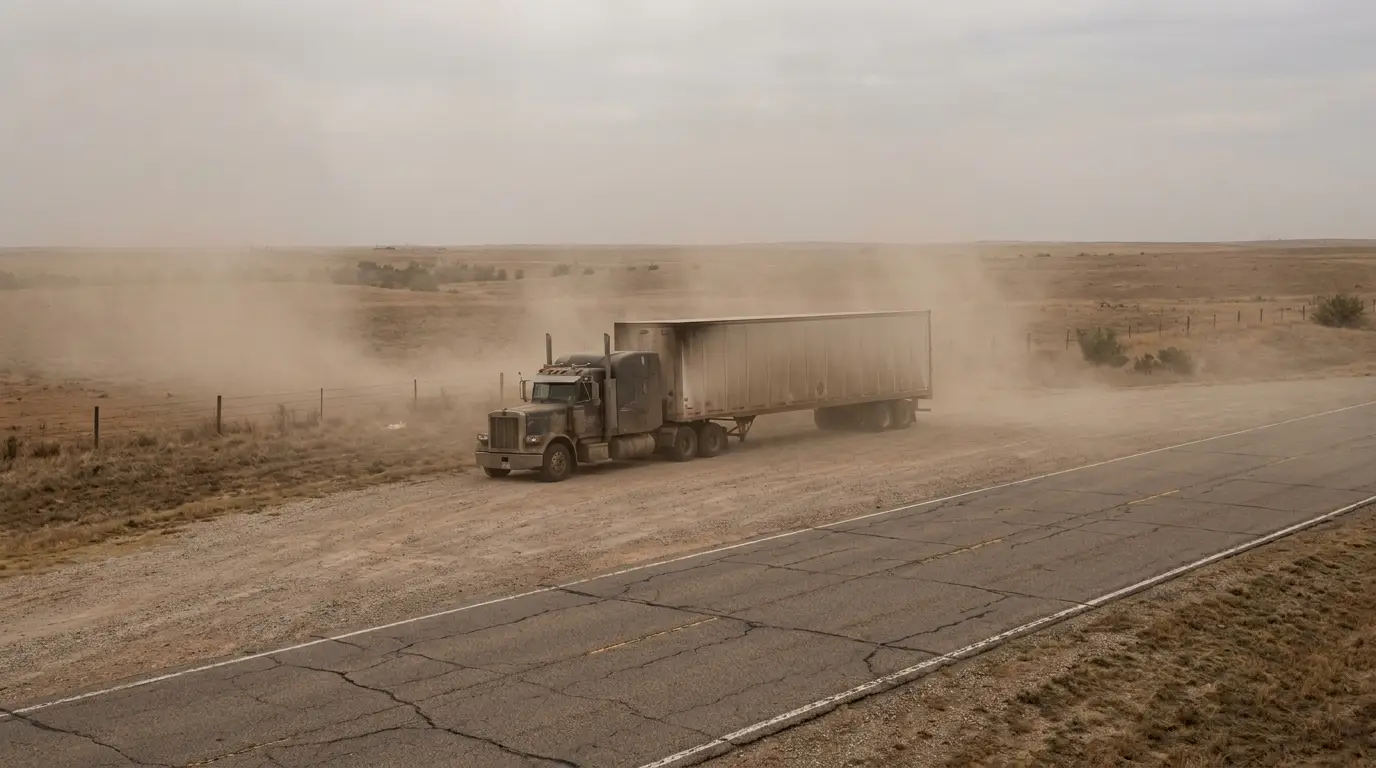
A tractor struck while parked on a shoulder is a physical damage claim, and in a multi vehicle wreck the paint and the glass are the cheap part. Heavy recovery on a closed interstate is billed by the hour. The days the truck then sits waiting on a shop in Colby or Goodland are not paid by a standard form at all. Loss of use is bought separately, and most owner operators learn that the week they need it.
The liability side is where the numbers get serious. On March 14, 2025 a dust storm on I-70 near Goodland produced a 71 vehicle pileup that killed eight people. A crash on that scale does not resolve against one claimant, and the federal minimum of $750,000 for general freight is not built to absorb a queue of them. Commercial auto liability limits are the one thing you cannot buy after the fact, so size them against the worst day on your worst lane.
Look at your limits before December
Dust season opens in December, which makes the next few months the right window to review your limits instead of doing it from the shoulder of I-70. Get a truck insurance quote in under a minute, or call or text 423-264-4255 and talk to a real person. For the state level detail, start with our Kansas truck insurance page.
Common questions
Is a crash caused by blowing dust covered by my truck insurance?
Yes. Blowing dust is not an exclusion on a standard commercial auto or physical damage form, so liability and physical damage respond the same way they would in any other crash. What the weather changes is the size of the file, because low visibility crashes tend to involve several vehicles and because 49 CFR 392.14 gives the other side a written standard of care to argue against. If you want your Kansas exposure reviewed, call or text 423-264-4255.
Should my drivers turn their flashers off in a Kansas dust storm?
That is a real conflict and you should settle it before the season, not on the shoulder. KDOT and the Kansas Highway Patrol advise turning off all lights while parked so nobody follows your taillights into you. Federal rule 49 CFR 392.22 requires hazard flashers immediately when a commercial vehicle stops on a highway and warning devices placed within 10 minutes. Write down what your drivers are expected to do, train it, and keep the record.
Does my policy pay for the days my truck sits after a dust storm wreck?
Not under a standard physical damage form. That coverage pays to repair or replace the truck, and the revenue lost while it waits on a shop is a separate purchase, usually sold as downtime, loss of use or rental reimbursement. If you run western Kansas from December through April, ask what it costs to add before you need it.
How much liability should I carry running western Kansas?
The federal floor for general freight is $750,000, and that is a floor rather than a target. A dust pileup on I-70 can involve dozens of vehicles and multiple serious injuries, which is exactly the scenario that runs past a minimum limit. Most owner operators running that corridor should be looking at $1 million and considering excess above it. Get a truck insurance quote and we will price both so you can compare.
Ready for a better rate?
We shop A-rated carriers against each other to find your lowest rate, fast. Under a minute to start, and no obligation.
Prefer to talk it through? Call or text (423) 264-4255 and a licensed agent will walk you through your options.