An 80.9 Million Dollar Misclassification Deal Just Put A Price On Your Lease
Classification is not a payroll footnote. It decides which policy answers when you get hurt, and whose balance sheet is standing behind the promises in your lease.
A drayage settlement just put a number on the classification question
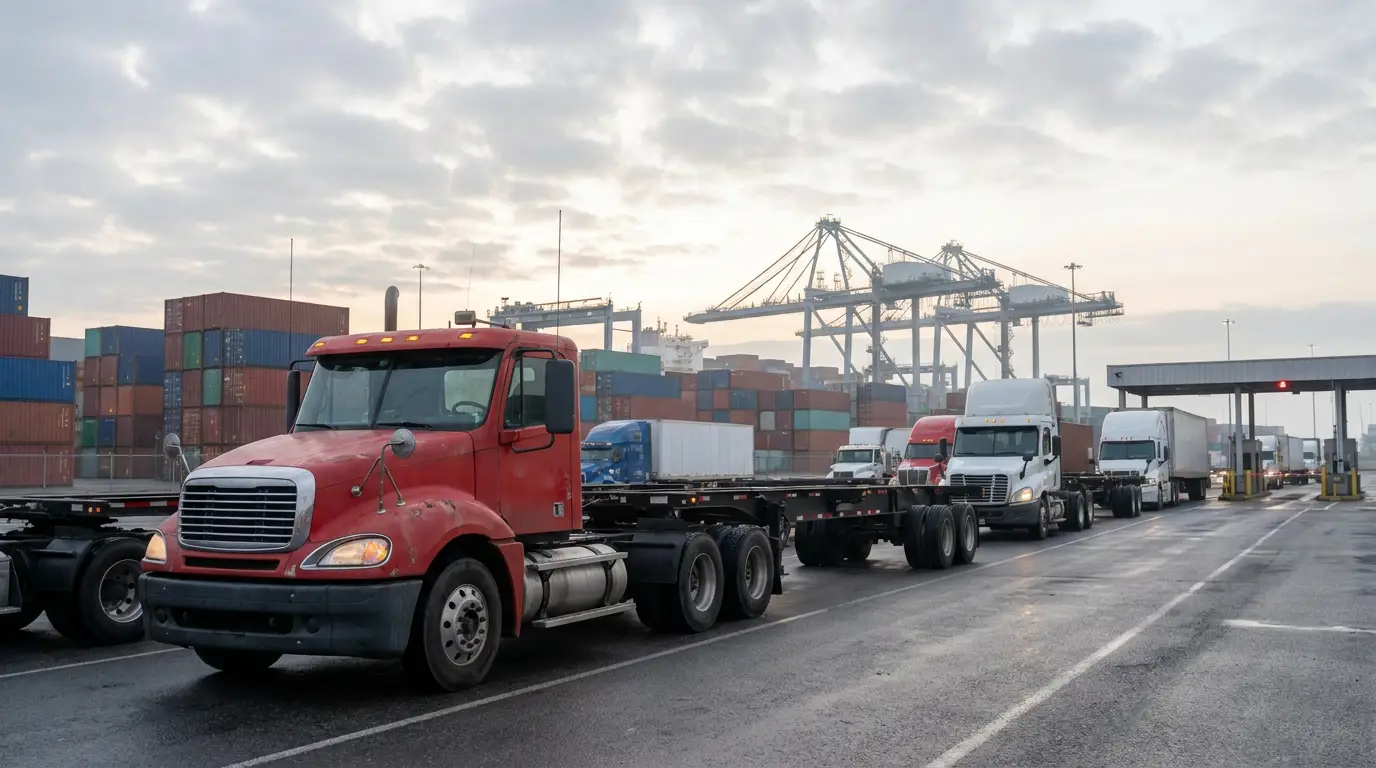
On August 3, 2026 FreightWaves reported that STG Logistics settled a New Jersey driver misclassification case brought over its drayage operation. The headline figure is 80.9 million dollars. The number the drivers will actually see is far smaller. Roughly 2.2 million dollars goes out to drivers as lump sums calculated from what each one earned from January 1, 2017 forward, and another 555,000 dollars goes to the state as penalties and contributions to benefit funds. The remaining 70 million plus sits as general unsecured claims inside a Chapter 11 that already erased about 90 percent of the company's debt.
The case has a long tail. New Jersey opened its investigation in 2019 and filed suit in Essex County in 2023 over a drayage business that belonged to XPO before STG bought it in 2022.
New Jersey writes the ABC test into the rulebook on October 1
Until now the state's ABC test lived in case law. On May 5, 2026 the New Jersey Department of Labor adopted final regulations that spell it out in writing, and those rules take effect October 1, 2026.
The test presumes the worker is an employee, and the company has to prove all three prongs to call that worker a contractor. A, the worker is free from control or direction over how the work gets done, both under the written contract and in actual practice. B, the work falls outside the usual course of the company's business or is performed away from its places of business. C, the worker is customarily engaged in an independently established business of the same kind. State agencies said STG met none of the three.
The detail every leased on owner operator should read twice
Here is the part worth sitting with. Lisa Yakomin, president of the Association of Bi-State Motor Carriers, told FreightWaves that the state pointed to STG signage on the trucks as evidence of control. Federal motor carrier rules require the operating carrier's name and USDOT number to be displayed on the vehicle. You cannot legally run without it. Yakomin described the state as saying the quiet part out loud.
Set the merits aside. There is a gap between what federal rules force a leased on operation to do and what a state classification test reads as control, and you are the one standing in the middle of it.
Why this lands on your insurance and not just somebody's payroll
Classification is not a human resources technicality. It decides which policy answers when you get hurt and when you cause a loss.
Start with injury coverage. A leased on owner operator treated as a contractor normally carries occupational accident coverage, often with the premium charged back through the lease. Reclassify that same driver as an employee and the exposure becomes workers compensation, a state mandated system with different benefits and real penalties for operating without it. Occupational accident is not a substitute and a state agency will not accept it as one.
Then look at the hours you are not under dispatch. Non trucking liability, what most people call bobtail, exists because the motor carrier's policy covers you while you are on their business and stops when you are not. The lease draws that line, and a classification dispute is an argument about whether anything covers you at 9 p.m. on a Sunday.
Physical damage is the simplest piece. If it is your truck and your note, it is your physical damage policy whichever way the classification question comes out. The same goes for a container chassis operation, where intermodal coverage terms decide who pays for equipment that was never yours.
The second lesson is about who is good for the money
STG's deal is worth 80.9 million dollars on paper and about 2.775 million dollars in claims that actually got priority. The rest went where unsecured claims go in a bankruptcy.
Whatever a motor carrier promises to cover for you in a lease is worth exactly what that carrier's balance sheet is worth on the day you need it. A certificate is a snapshot, not a guarantee. Coverage written in your own name does not go through Chapter 11 with somebody else's company, and your own commercial auto liability does not disappear because a carrier stopped answering the phone.
What to check before October 1
Pull your lease and write down three columns. Which policies the carrier carries, which ones you carry, and which ones are charged back to you out of your settlement. Ask for actual certificates rather than a summary. Confirm you have coverage for the hours you are off dispatch, and confirm whether your injury coverage is occupational accident or workers compensation, because those two are not interchangeable in a claim.
None of this means changing how you run. It means knowing what is actually in your own name before somebody else's paperwork decides it for you. Get a truck insurance quote in under a minute and we will walk your lease with you and point out exactly which gaps you are carrying yourself. Call or text 423-264-4255, or start your quote here.
Common questions
Does the STG settlement mean leased on owner operators are employees now?
No. The settlement resolved one company's New Jersey case and did not reclassify anyone else. What it shows is how a state agency applies the ABC test to a drayage operation and how expensive the answer can get. Leasing on to a motor carrier remains legal and common. The point is to know which coverages sit in your name rather than assuming the carrier's policy reaches you.
What is the ABC test and why does it matter to truck drivers?
It is the standard New Jersey uses to decide whether a worker is an employee or an independent contractor. The worker is presumed to be an employee, and the company must prove all three prongs to rebut that. Freedom from control over the work, work performed outside the company's usual business or premises, and the worker running an independently established business of the same kind. New Jersey put the test into formal regulation effective October 1, 2026.
Does occupational accident coverage count as workers compensation?
No, and treating them as the same thing is a costly mistake. Occupational accident is a contractual benefit policy with stated limits and exclusions. Workers compensation is a state mandated system with statutory benefits and penalties for operating without it. If a classification finding turns a contractor into an employee, an occupational accident policy will not satisfy the workers compensation obligation. Call or text 423-264-4255 if you are not sure which one you actually have.
What truck insurance should a leased on owner operator carry in their own name?
At minimum, non trucking liability for the hours you are off dispatch, physical damage on your own tractor if you hold the note, and your own injury coverage. Many owner operators also carry occupational accident and a small cargo limit depending on what the lease requires. Get a truck insurance quote and bring the lease so the gaps show up on paper instead of after a loss.
Ready for a better rate?
We shop A-rated carriers against each other to find your lowest rate, fast. Under a minute to start, and no obligation.
Prefer to talk it through? Call or text (423) 264-4255 and a licensed agent will walk you through your options.