Driverless Trucks Got A Pass On Warning Triangles, Yours Did Not
A petition filed September 8 asks the Seventh Circuit to review the waiver that lets driverless trucks skip warning triangles. Nothing in it changes what a human driver has to do on the shoulder.
Overdrive reported on September 18, 2026 that an Illinois cargo van operator named Kostas Giannoulias has asked the U.S. Court of Appeals for the Seventh Circuit to review an FMCSA order that lets autonomous trucks use cab mounted warning beacons instead of putting warning triangles on the ground. The petition was filed September 8 and it targets the agency's July 9 waiver order. Land Line has been tracking the same fight since Aurora first went to court over it.
What the waiver actually covers
FMCSA issued Aurora Operations a limited waiver from the warning device placement requirements, the steady burning lamp requirement, and the rules on the types and number of warning devices a stopped commercial vehicle has to display. The waiver window runs from July 10, 2026 through October 9, 2026. The part that got attention is that FMCSA opened it up, so other developers running Level 4 automated trucks can operate under the same waiver by notifying the agency in writing. Kodiak Robotics has already filed that notice. A separate five year exemption request from Aurora is still working its way through the process, and the Owner Operator Independent Drivers Association has been on record against it, arguing among other things that a cab mounted beacon does nothing for a truck stopped just past a blind curve.
None of that touches you. If a person is behind the wheel, the original rule is still the whole rule.
The rule that still applies to your truck
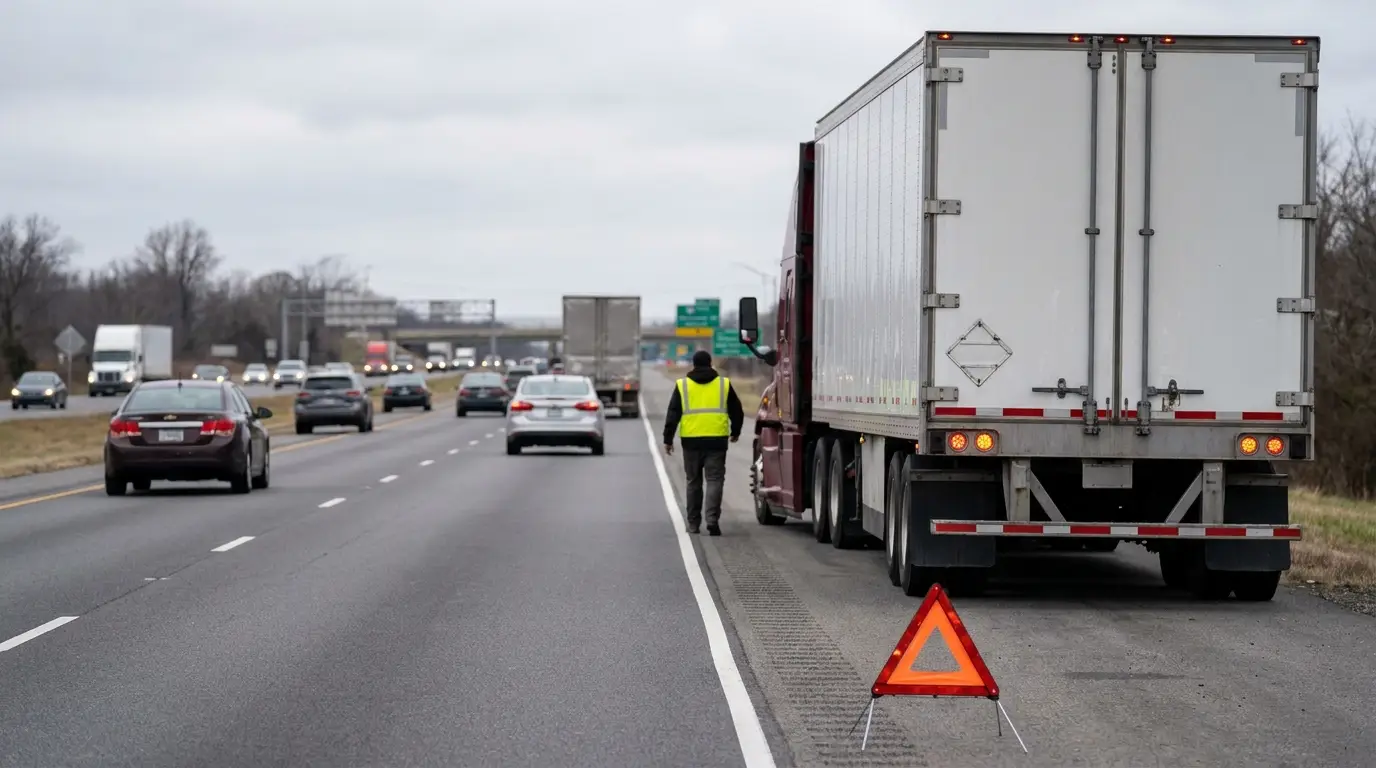
49 CFR 392.22 has not changed. The second a commercial vehicle stops on the traveled portion or the shoulder of a highway for any reason other than a necessary traffic stop, the driver has to hit the hazard flashers immediately and keep them going until the warning devices are down. Then the devices themselves, the ones spelled out in 393.95, have to be placed as soon as possible and in any event inside ten minutes.
The placement is specific. One device goes on the traffic side about ten feet from the truck toward approaching traffic. One goes a hundred feet back toward approaching traffic in the center of the lane or shoulder you are occupying. One goes a hundred feet the other way. On a divided or one way road the spacing changes to two hundred feet and one hundred feet toward approaching traffic, with the third device at the traffic side near the rear. And if you are stopped within five hundred feet of a curve, the crest of a hill, or anything else blocking the view, you have to move the device on that side out to somewhere between a hundred and five hundred feet so drivers actually get a warning before they see you.
Ten minutes is a number a lawyer can work with
Here is why a rule about orange plastic belongs on an insurance site. When a passenger car hits a truck parked on a shoulder, the claim almost never turns on the breakdown. It turns on what the driver did in the minutes after it. A plaintiff attorney will pull the ELD, the dashcam, and the dispatch log, build a timeline, and ask whether the triangles were down inside ten minutes. If they were not, a defensible secondary collision becomes a negligence argument, and your commercial auto liability limits are suddenly the thing being tested instead of the other driver's attention.
It cuts the other way too. A driver who deployed correctly and photographed it has a comparative fault story an adjuster can actually use. The same file that protects the liability side protects the physical damage claim on your own tractor, because it establishes where the truck was and how it was marked when it got hit.

What to keep in the truck and in the file
Carry three bidirectional reflective triangles that meet 393.95 and know where they are without thinking. If you run fusees instead, at least one has to stay lit at every location the entire time you are stopped. Check the triangles at your pre trip the way you check a fire extinguisher, because a cracked or missing one is a violation before anything has even happened.
Then document it. Flashers on, triangles out, four photos, one from a hundred feet back showing the device in frame with the truck. Note the time. That takes two minutes and it is the cheapest claims defense you will ever buy. Carriers that do this consistently tend to see it show up later in what they pay for truck insurance, because the loss runs stay clean.
The takeaway for a small fleet
Autonomous developers are spending years and real legal money to skip a step that takes a human driver ninety seconds. That tells you how much weight the industry puts on it. Whatever the Seventh Circuit does with the September 8 petition, the waiver is written for driverless equipment. Your trucks are covered by the rule as written, and so is your claims file.
If you want to know whether your current policy would hold up in the kind of shoulder collision this rule exists to prevent, we can look at it with you. Get a truck insurance quote in under a minute, or call or text 423-264-4255 and talk it through with someone who reads these policies all day. Start with a quick quote request and we will take it from there.
Common questions
Does the FMCSA autonomous truck waiver apply to my truck
No. The July 9, 2026 waiver is written for Level 4 automated commercial vehicles operated by Aurora and by other developers who notify FMCSA in writing that they intend to operate under it. A truck with a person driving it is still fully subject to 49 CFR 392.22 and has to place warning devices on the ground.
How long do I have to put out warning triangles
As soon as possible, and in any event within ten minutes of stopping. Hazard flashers have to go on immediately and stay on until the devices are placed. The ten minute clock is the number that shows up in accident reconstruction, so treat it as the deadline rather than the target.
Can failing to place warning devices affect a truck insurance claim
It can change the shape of the claim. It does not void your coverage, but it hands the other side a clean negligence theory in a secondary collision case, which pushes settlement value up and can put your liability limits in play. Documenting correct placement does the opposite. If you are unsure your limits fit that exposure, call or text 423-264-4255.
What warning devices am I actually required to carry
Three bidirectional reflective triangles meeting the standards in 49 CFR 393.95, or lighted fusees used under the special rules in 392.22. If you run only fusees, one has to stay lit at each required location for as long as the vehicle is stopped. Missing or damaged devices are a violation on their own at a roadside inspection. You can get a truck insurance quote and review your equipment exposure at the same time.
Ready for a better rate?
We shop A-rated carriers against each other to find your lowest rate, fast. Under a minute to start, and no obligation.
Prefer to talk it through? Call or text (423) 264-4255 and a licensed agent will walk you through your options.