One Accident Can Set Off More Than One Deductible
Physical damage, cargo, and liability each carry their own deductible and their own clock
Most owner operators pick a deductible once, at the quote, and never think about it again until a truck is sitting on a hook. The number on the declarations page is not the number you fund after a crash. One accident usually touches more than one coverage part, and every part carries its own deductible. Our guide to setting truck insurance deductibles on a one to five truck fleet covers picking the number. This is the week you use it.
One accident, several coverage parts
Picture a loaded tractor trailer that leaves the road. The tractor is damaged, the trailer is damaged, the freight is ruined, and somebody in the other vehicle is hurt. That is four exposures out of one event and they sit in different places on the policy. Physical damage answers for the equipment, cargo for the freight, liability for the other party. So the question after a wreck is not what is my deductible. It is how many of them this accident touched.
The paperwork starts before any of the money does. Under 49 CFR 390.5 a federal accident is one with a fatality, a bodily injury where somebody immediately gets medical treatment away from the scene, or disabling damage that requires a vehicle to be transported away. Once it meets that test, 49 CFR 390.15(b) has you keeping an accident register for three years with the date, the location, the driver, the injury and fatality counts, and whether hazardous material was released. That gets filled out whether you file a claim or pay the repair yourself.
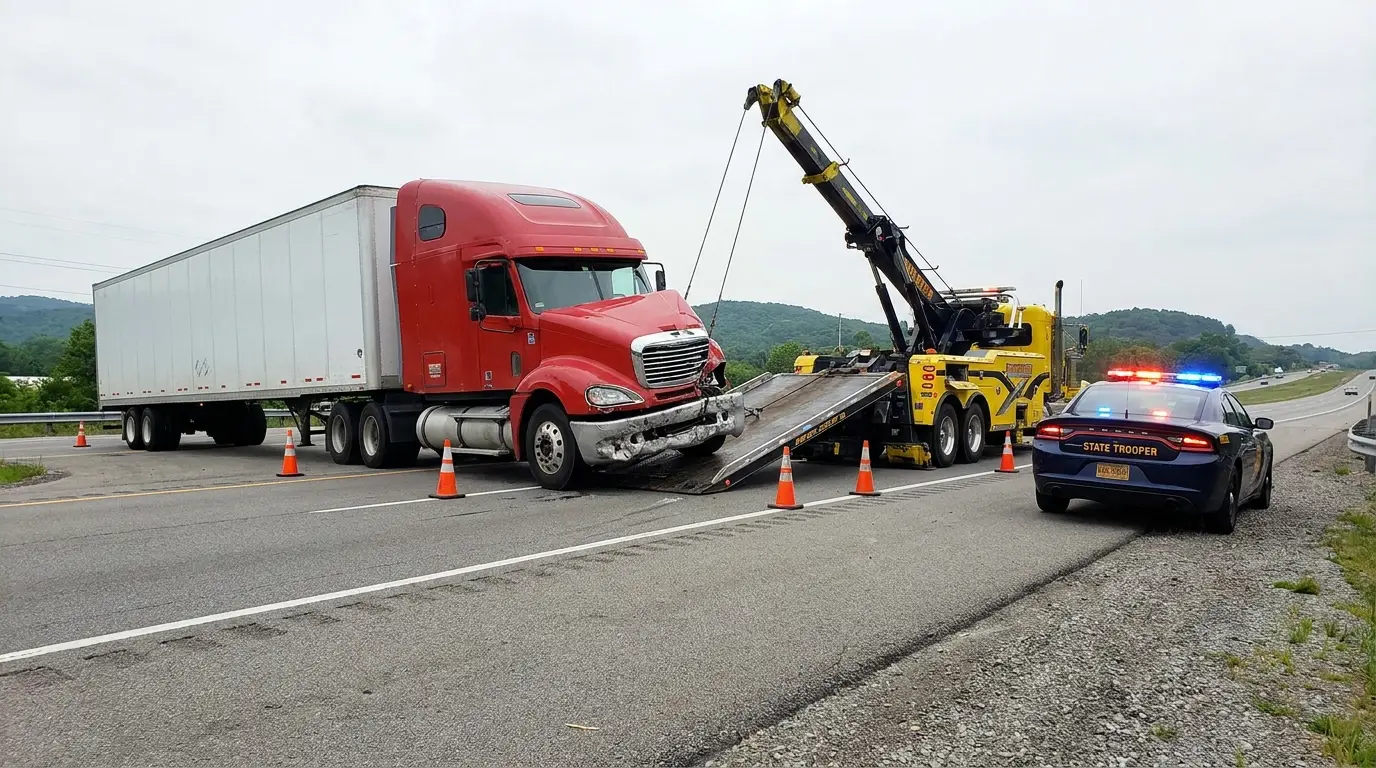
The tractor and the trailer are not one deductible
Physical damage deductibles commonly attach per unit rather than per accident. If the tractor and the trailer are scheduled separately, damage to both can mean two deductibles out of one phone call to your agent. Read your own physical damage coverage for the words per vehicle and per occurrence, because that one phrase decides whether you write one check or two.
There is also a repair clock that has nothing to do with the insurance company. If an inspector puts the vehicle out of service, 49 CFR 396.9(c)(2) says nobody may operate it until all repairs on the out of service notice are satisfactorily completed, and 396.9(d)(3) requires certification within 15 days of the inspection, with a copy kept at your principal place of business for 12 months. The deductible has to be funded before the truck earns again, not after the claim settles.
The cargo claim moves on its own clock
Freight damage is the slowest money in the file. Cargo claims run under 49 CFR part 370, where a carrier has 30 days to acknowledge a written claim under 370.5 and 120 days after receipt to pay it, decline it, or make a firm compromise settlement offer in writing under 370.9, with a written status update every 60 days after that while it stays open. Your motor truck cargo coverage sits behind its own deductible on top of that timeline, so one bad load can be cash out of your account for months.

There is no federal cargo floor to fall back on for general freight either. The only federal cargo minimums still in place are at 49 CFR 387.303(c) for household goods carriers, 5,000 dollars for loss or damage on any one motor vehicle and 10,000 dollars for losses at any one time and place. Everything else is settled by your policy form and the commodity schedule on it.
On liability the deductible is not the ceiling
Liability is where the word deductible misleads people the most. Your federal filing runs on the MCS-90 endorsement, which says no condition, provision, stipulation, or limitation in the policy relieves the insurer from paying a final judgment for public liability. The next sentence is the one nobody reads. The insured agrees to reimburse the company for any payment made on account of any accident, claim, or suit involving a breach of the terms of the policy, and for any payment the company would not have been obligated to make except for that endorsement. The insurer fronts the money to the public, then looks to you for it.
Two more lines in that form matter to a small fleet. The limits apply separately to each accident, so one bad month does not spend down what is there for the next one. And the public liability it covers does not apply to property transported by the insured and designated as cargo, so it is no backstop on a freight claim. The federal floor under general freight is 750,000 dollars at 49 CFR 387.9, written to protect the public rather than to cap what you can be sued for.
What to check before you need any of this
Pull the declarations page and answer four questions. Does the physical damage deductible apply per vehicle or per occurrence. Is the trailer scheduled with a deductible of its own. What is the cargo deductible and does it move by commodity. Is there an aggregate that stops the bleeding after a run of claims in one year. Then add up the worst realistic day and compare it against what you could move in 72 hours without touching payroll. If those numbers are nowhere near each other, the deductible is too high for the fleet no matter how good the premium credit looked. The rest of that decision sits in our small fleet deductible guide.
If you are not sure how many deductibles your current policy would set off in a single accident, we will read the declarations page with you and price it side by side. Get a truck insurance quote in under a minute on our quote form, or call or text 423-264-4255 and we will go through it line by line.
Common questions
Does one accident only mean one deductible?
Not usually. Physical damage, motor truck cargo, and liability are separate coverage parts with separate deductible wording, and physical damage often applies per unit, so a tractor and a trailer damaged in the same wreck can each carry one.
Does the MCS-90 endorsement cover my cargo claim?
No. The endorsement covers public liability and states that it does not apply to property transported by the insured and designated as cargo. Freight damage is answered by motor truck cargo coverage and its own deductible.
How fast do I have to fix a truck that was put out of service?
Under 49 CFR 396.9(c)(2) nobody may operate it until all repairs on the out of service notice are satisfactorily completed, and 49 CFR 396.9(d)(3) requires certification within 15 days of the inspection, with a copy kept at your principal place of business for 12 months.
How long can a cargo claim stay open?
A carrier has 30 days to acknowledge a written claim and 120 days after receipt to pay it, decline it, or make a firm settlement offer, with written status updates every 60 days after that. Plan the cash around that timeline. Get a truck insurance quote or talk it through by calling or texting 423-264-4255.
Ready for a better rate?
We shop A-rated carriers against each other to find your lowest rate, fast. Under a minute to start, and no obligation.
Prefer to talk it through? Call or text (423) 264-4255 and a licensed agent will walk you through your options.