The Deposition Is Where a Truck Crash Becomes a Verdict
FreightWaves reported on August 14 that a fleet compliance bootcamp is adding a live deposition simulation. The reason is worth ten minutes of your time, because in a truck crash case the number is set by what your files say, not by what happened on the road.
A compliance bootcamp just added a deposition simulation
FreightWaves reported on August 14 that Trucksafe Consulting is adding a half day live deposition simulation to its fifth annual Fleet Compliance Bootcamp, which runs September 16 and 17 in Indianapolis with the simulation session the following day. Brandon Wiseman, the firm's president and founder, told FreightWaves that a compliance failure rarely stays inside an enforcement proceeding anymore, and that the way plaintiff attorneys frame their questions is, in his words, not all that intuitive. The session seats attendees around a table while attorneys work a fictional case, so people can see the traps before they meet one under oath.
A training seminar is not a rule change, and nobody has to attend. It is still worth an owner operator's attention, because of what it says about where a truck crash claim actually gets decided.
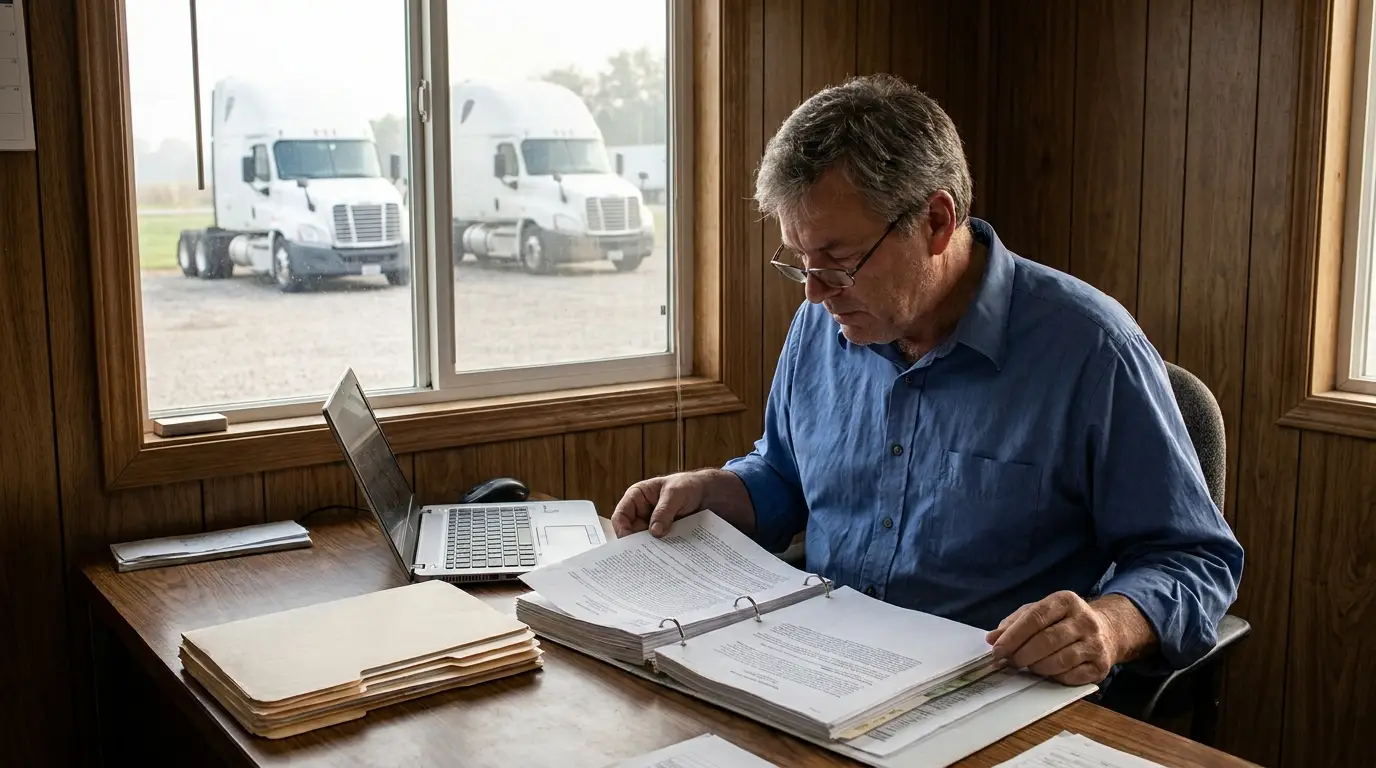
The crash sets the facts, the deposition sets the number
Most people picture a courtroom. Almost nothing gets there. ATRI counted an estimated 12,817 tractor trailer tort cases in state courts in 2022, and only 487 of them finished at trial. Everything else resolved some other way, and those resolutions get priced off the record built during discovery. The deposition is the loudest part of that record, because it is you, under oath, on video, explaining your own paperwork in your own words.
There is one rule small carriers get caught by in particular. Under Federal Rule of Civil Procedure 30(b)(6), a plaintiff can notice a deposition of your company rather than of a named person, list the subjects in advance, and require you to produce somebody prepared to answer for the business on every one of them. In a one truck or five truck operation, that somebody is you. I do not know is not a safe answer, because the rule expects you to have gone and found out.
They are not really asking about the crash
This is the part that catches people off guard. The questions run to driver qualification files, hours of service records, the drug and alcohol testing program, maintenance history, hiring standards, the written policies you say you follow, and your CSA record. The theory is negligent hiring, training, retention or supervision, and it does not need your driver to have done anything dramatic. It needs a hole in your file.
Which is also why a clean record is worth more than a premium credit. The same documents an underwriter reads at renewal are the documents a plaintiff attorney reads in discovery, and both are grading the same thing. Our breakdown of how a CSA score prices into your premium covers the underwriting half of that.
Where your limits come into it
ATRI's earlier work on large awards logged 26 verdicts above $1 million between 2006 and 2019, and close to 300 across the five years that followed. Where a verdict cleared $1 million, the median landed at $3.6 million in state court and $2.5 million in federal court, and settlement values have been climbing at roughly 5.7 percent a year.
Now set that against the $750,000 federal minimum, which has not moved since 1985. Your commercial auto liability limit is the ceiling on what your insurer defends and pays. Past it, the demand is pointed at your trucks, your receivables and your house. That is the entire argument for buying above the filing requirement and adding an excess layer over it, and it is a cheaper conversation than most owner operators expect. Our guide to what commercial truck insurance actually costs puts real numbers against the difference.

Four things to do long before anyone notices your deposition
Keep a complete qualification file on every driver including yourself, with the motor vehicle record, the application, the road test and a current medical card. Write down the policies you actually follow instead of downloading a manual you do not enforce, because an unfollowed policy reads worse under oath than no policy at all. Preserve everything the day of a crash, meaning ELD data, telematics, dispatch messages and maintenance records, and call your agent that same day. And read your own file once a year the way a stranger would, since the first time you notice a gap should not be with a court reporter in the room. Our walkthrough of what happens after an at fault accident puts that timeline in order.
If your limits have not been looked at since you bought the truck, they are priced for a world that no longer exists. Get a truck insurance quote in under a minute and we will walk your liability, excess, physical damage and cargo limits against how you actually run. Start your quote here or call or text 423-264-4255.
Common questions
What is a 30(b)(6) deposition and why does it matter to a small carrier?
It is a deposition of your company rather than of a person. The plaintiff lists the topics in advance and you have to produce someone prepared to speak for the business on each one. In a small operation that is the owner, and answers given there bind the company. The preparation is the whole game, because you are expected to go learn anything you do not already know.
Does my truck insurance pay for the lawyer at a deposition?
Yes, defense costs sit inside your liability coverage, and your insurer assigns and pays counsel once a claim is reported. That is a reason to report early rather than wait and see whether a demand letter shows up. Call or text us at 423-264-4255 if you are not sure what your policy actually does here.
What records will a plaintiff attorney ask for?
Driver qualification files, hours of service and ELD data, drug and alcohol testing records, maintenance and inspection history, dispatch records, hiring and training policies, and your CSA history. Most of it is paperwork you are already required to keep, which is why the gaps stand out so clearly when they exist.
Is $750,000 in liability enough?
It is the federal minimum for general freight and it has not changed since 1985. ATRI data shows the median award in truck cases that cleared $1 million was $3.6 million in state court. The minimum is a filing requirement, not a safety target. Get a truck insurance quote and we will price what a higher primary limit plus an excess layer actually costs you.
Ready for a better rate?
We shop A-rated carriers against each other to find your lowest rate, fast. Under a minute to start, and no obligation.
Prefer to talk it through? Call or text (423) 264-4255 and a licensed agent will walk you through your options.